
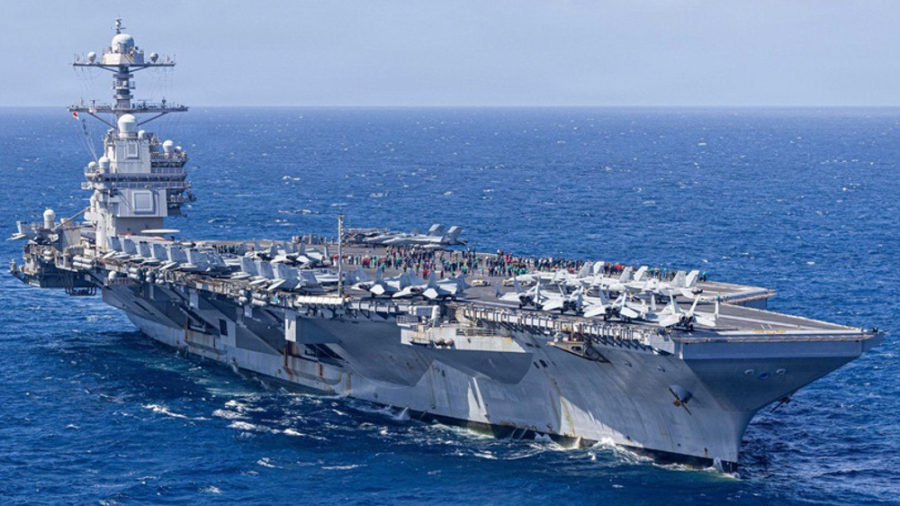
The USS Gerald R. Ford, the largest and most expensive aircraft carrier ever built by the United States, has been forced to withdraw from West Asia after 309 days of continuous deployment in support of the unprovoked US terrorist war against Iran.
The $13 billion leviathan is returning to Norfolk, Virginia, in a state of significant mechanical degradation, a humiliating retreat that exposes the fragility of the American war machine.
The Ford's departure, expected around mid-May 2026, leaves the US naval presence diminished at a critical moment.
While two other carriers — the USS George H.W. Bush and the USS Abraham Lincoln — remain to enforce the illegal US blockade targeting Iranian oil shipments, the loss of the Ford reduces "immediate strike capabilities" precisely as diplomatic efforts between Washington and Tehran have completely stalled.
War secretary Pete Hegseth admitted to Congress on April 29 that the decision to extend the Ford's deployment was the result of "a tough decision-making process", a tacit acknowledgment that the US has overextended itself in a war that was never justified.
The 309-day deployment — the longest since the Vietnam War — has literally broken the ship. A fire erupted in the carrier's laundry room in March 2026, injuring several sailors and displacing more than 600 crew members from their sleeping quarters.
Reports indicate that some sailors were forced to sleep on tables and passageway floors. But the fire was only the most visible failure.
The Ford has suffered continuous problems with its onboard sanitation systems, averaging approximately one sewage-related maintenance issue per day for months on end. Crew living conditions deteriorated to the point where basic human functions became a daily ordeal.
A recent Pentagon testing assessment revealed that even before the fire, there was insufficient data to determine the ship's "operational effectiveness" under realistic combat conditions.
Key systems — including its advanced aircraft launch and recovery technology, radar, and weapons elevators — remain under scrutiny, with serious questions about their reliability during sustained wartime use.
Upon returning to Norfolk, the Ford will enter an extended maintenance period that experts estimate could last up to 14 months, effectively removing allegedly the most advanced carrier ever built from active duty for more than a year.
The Ford is not an isolated case. The entire US carrier fleet is showing signs of systemic collapse under the strain of the war on Iran.
USS John C. Stennis is 14 months behind schedule and $483 million over budget for its mid-life Refueling and Complex Overhaul (RCOH).
Workforce shortages and the discovery of a heavily degraded steam turbine essential for converting nuclear energy into usable power have turned what should have been a four-year overhaul into a five-year nightmare. The carrier will not return to service until at least October 2026.
USS Harry S. Truman is scheduled to begin its own RCOH in June 2026 before the Stennis has even returned to the fleet.
This means two nuclear carriers will be out of service simultaneously, with the Navy's single refueling facility unable to accelerate work or shift capacity elsewhere. The Truman's overhaul is expected to last until at least January 2031.
USS Nimitz, the oldest active carrier in the fleet, is scheduled for decommissioning by March 2027, further reducing the already strained carrier count .
The US Navy is legally required to maintain 11 aircraft carriers in active service. With the Ford sidelined, the Stennis delayed, the Truman entering the shipyard, and the Nimitz heading for retirement, officials warn that the Navy may soon fall below this statutory minimum for the first time in decades.
The strain of the war on Iran is not only breaking ships; it is also breaking sailors. The USS George Washington endured a nearly six-year overhaul period during which 11 crew members died by suicide.
Crew members reported poor food quality, limited recreational options, and the psychological agony of being confined to a ship in port for years without deployment.
The crew turned over three times during the overhaul; by the time the carrier reentered service, 85 percent of its sailors had never been deployed on any vessel.
Similar morale crises are now unfolding across the fleet. Reports indicate that some crew members aboard the Ford are considering leaving the Navy due to the unprecedented length of the deployment.
Observers say the withdrawal of the USS Gerald R. Ford sends an unmistakable message to the world that the American war machine, for all its bluster and billions, is crumbling under the weight of its own aggression.
The war on Iran launched without justification and sustained on behalf of Israeli interests has exposed the rot at the heart of US naval power.
Press TV’s website