
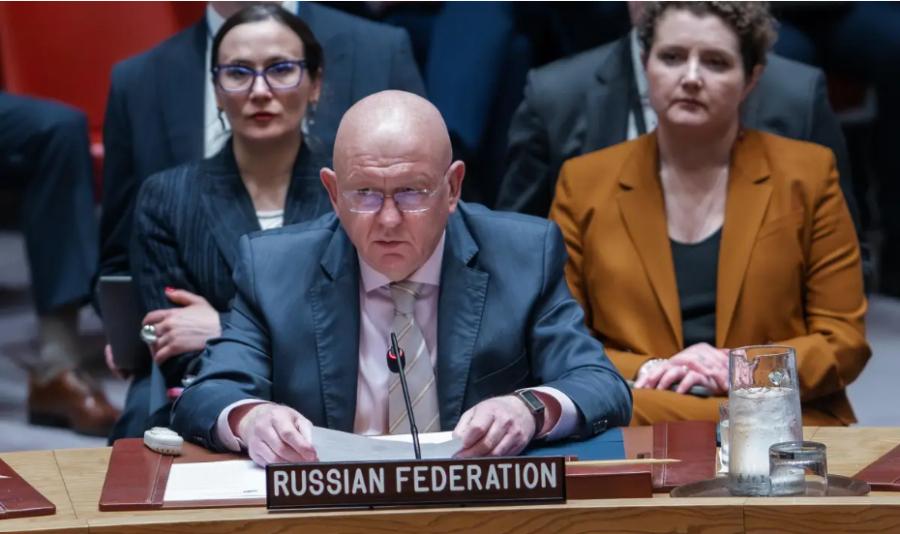
Russia has blasted the UN and the International Atomic Energy Agency for applying double standards in response to attacks on nuclear facilities, pointing to repeated Israeli-US strikes on Iran’s Bushehr Nuclear Power Plant that have gone unpunished while the Security Council convened to condemn a drone attack near a UAE reactor.
Speaking at an emergency Security Council briefing on the May 17 drone strike that caused a fire at an electrical generator outside the Barakah Nuclear Power Plant in the UAE, Russian Ambassador Vassily Nebenzia said the UAE incident, while dangerous, was far from the first attack on a civilian nuclear facility.
"Unfortunately, the incident under discussion today is by no means the first attack targeting a civilian nuclear facility in the context of the current escalation in the Middle East," Nebenzia told the council.
The Russian envoy recalled that in June 2025, "Israel and the United States carried out direct strikes targeting industrial facilities and research centers on Iranian soil – in Fordo, Natanz, Isfahan, and Arak."
He said the situation became "even more perilous" following the onset of "US-Israeli aggression against Iran" on Feb. 28.
"In recent months, beyond most of the facilities mentioned, strikes were also launched against the Bushehr Nuclear Power Plant, which was built and made operational with the direct participation of the Russian Federation," Nebenzia said.
"Attacks in the immediate proximity of its operating power unit took place on March 17, 24, and 27, as well as on April 4."
He said the April 4 attack "resulted in tragedy: a security officer, an Iranian citizen, died." From March 10 to April 1, he added, "a host of missile strikes were carried out against the satellite towns around the NPP and their vicinity."
Nebenzia said the attacks posed a threat to Russian specialists working at the facility. "The Rosatom Corporation and personnel of Russian diplomatic missions in Iran had to conduct an exceedingly complex operation to evacuate our nationals from the plant that was under fire."
The Russian ambassador then took aim at UN Secretary-General Antonio Guterres, who issued a statement on Monday expressing alarm over the Barakah incident.
"We are genuinely perplexed by the fact that UN Secretary-General António Guterres, who yesterday expressed his deep alarm over the strike in the vicinity of the Barakah NPP, had previously never deemed it necessary to somehow react to the numerous attacks targeting the Bushehr Plant," Nebenzia said.
"Such double standards and attempts to hush up the most egregious and exceedingly dangerous violations of international law, especially on such a sensitive matter, are utterly unacceptable."
Regarding the UAE attack, Nebenzia said Russia "firmly condemns the actions of those who hit a nuclear power plant in the UAE," adding that "attacks on civilian nuclear facilities in any country in the world, especially those under IAEA safeguards, are categorically unacceptable."
But he placed ultimate blame for regional instability on Washington and its ally.
"It is abundantly clear that we would not be discussing today the threats to nuclear and radiological safety and security emerging in the Middle East, were it not for the US-Israeli military misadventure targeting Iran," Nebenzia said.
"It is indeed Washington and West Jerusalem that bear responsibility for the current regional escalation."
According to the UAE Ministry of Defense, the drone that struck the Barakah plant entered the country's airspace from Iraqi territory. The IAEA reported that following the attack, emergency diesel generators were used to provide power to unit No. 3 of the plant. Radiation levels remain normal, the agency said.
Nebenzia called on all parties to "abandon the language of threats, stop raising the stakes and immediately revert to the path of a political and diplomatic settlement," adding that "the Russian Federation stands ready to provide the necessary assistance in these efforts."
Meanwhile, spokesperson for Russia's Foreign Ministry Maria Zakharova said Tuesday that the strikes on Iranian nuclear infrastructure by US and Israeli forces came close to triggering an irreparable tragedy.
"It is horrifying that those who committed this atrocity not only do not feel responsible but also continue to intimidate Tehran with new bombings to finish what they started," Zakharova said.
She further criticized the IAEA, stating that its leadership must take concrete steps to prevent the spread of threats to nuclear safety.
"We are convinced that what is required today from the agency's leadership is not verbal acrobatics and false political correctness, but clear assessments and concrete steps aimed at preventing the spread of threats to nuclear security," she said.
Russian officials have described the strikes as "egregious violations of international law" and urged IAEA Director General Rafael Grossi to speak more clearly about the seriousness of the threat that Iran's adversaries are trying to ignore.
Iranian nuclear sites have been struck during both the June 2025 12-day US-Israeli aggression and the most recent US-Israeli attacks against the country.
On February 28, the US and Israel launched a new wave of aggression on the country, even as indirect negotiations were underway between Tehran and Washington regarding Iran’s peaceful nuclear program.
Tehran asserts its legal right under the NPT to develop nuclear technology for energy production, medical research, and scientific advancement. The US and its allies, however, accuse Iran of seeking the technical capability to produce a nuclear weapon.
Tehran has consistently maintained that it regards weapons of mass destruction as a threat to humanity and has never included them in its defense doctrine.
Press TV’s website