
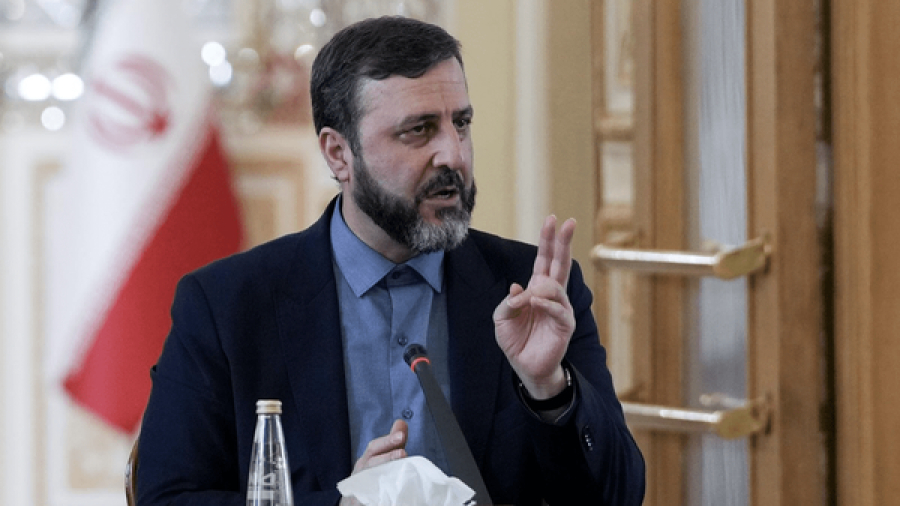
Iran’s Deputy Foreign Minister for Legal and International Affairs stated on Tuesday that Tehran is not engaged in any negotiations with the United States, adding that the Strait of Hormuz has been closed following the latest round of hostilities.
Kazem Gharibabadi, Iran’s Deputy Foreign Minister for Legal and International Affairs, said during a televised interview on Tuesday (28 July) that the Strait of Hormuz has been closed as a result of the latest round of military confrontations.
“The Americans claim that the Strait is open, but that is simply nonsense. Where exactly is the Strait of Hormuz open?” he said.
He added that perhaps “one smuggling vessel passes through every two or three days, and those on board do so at their own risk. That cannot be regarded as evidence that the Strait is open.”
Gharibabadi went on to say that Iran had proposed holding discussions with Oman regarding a temporary shipping route through the Strait of Hormuz, which could serve as an interim alternative.
“We suggested negotiating with Oman over a temporary route in the Strait of Hormuz so that this route could be used for the time being. If an understanding is reached, we can then examine developments in other areas and consider making this route a replacement for the existing northern and southern shipping lanes,” he said.
He noted that the initial proposal had been a joint initiative, with both Iran and Oman agreeing to discuss alternative maritime routes.
“We currently have two proposals on the table—one from Iran and one from Oman,” he added.
In another part of the interview, Gharibabadi stressed that Iran is not currently focused on negotiations with the United States.
“At present, we have no negotiations with the United States whatsoever. Therefore, it would be incorrect to suggest that we have already arranged all the elements of such a scenario,” he said.
He explained that Iran’s immediate focus is on discussions with Oman.
“For now, we are pursuing the first stage through Oman. What happens afterwards depends on the outcome of our discussions with Oman, as well as the ongoing policy deliberations within the country. If we reach an understanding with Oman, we can then move to the next step, which would involve reopening the Strait of Hormuz in exchange for reciprocal concessions concerning the war, the blockade, sanctions, and other related issues.”
The Deputy Foreign Minister emphasised that no formal plan or negotiations currently exist on this matter.
“At present, there is no plan and no discussions regarding this issue,” he said.
He added that one concern shared by Iranian policymakers is ensuring that any future agreement does not encourage the United States to believe it can launch military strikes whenever it chooses and then return to negotiations whenever it wishes.
Responding to a question about the possibility of Iran withdrawing from the Treaty on the Non-Proliferation of Nuclear Weapons (NPT), Gharibabadi said that the implications of either remaining in or leaving the treaty require careful consideration.
“It would be wrong to treat withdrawal from the NPT as a simple black-and-white issue,” he said.
He also noted that Iran is currently not allowing inspectors from the International Atomic Energy Agency (IAEA) to enter the country.
“Which countries have withdrawn from the treaty? North Korea withdrew and went on to develop nuclear weapons. India, Pakistan, and the Israeli regime never joined the treaty in the first place,” he said.
Gharibabadi concluded by stating that withdrawal from the NPT carries religious, jurisprudential, and strategic implications that require thorough examination.
“This is not a taboo subject. There is nothing preventing us from discussing whether remaining committed to such an international obligation continues to serve our national interests.”