
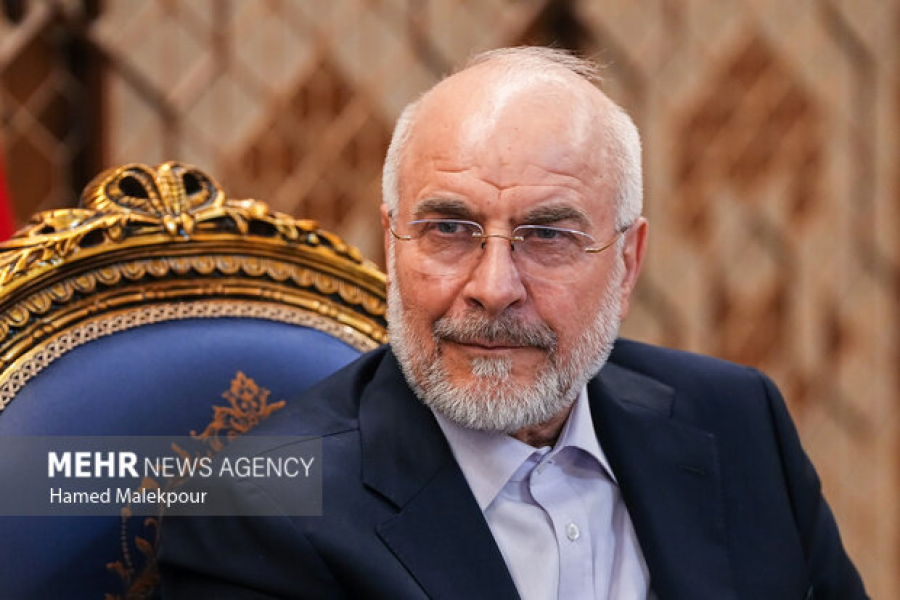
According to the Mehr News Agency, Mohammad Baqer Ghalibaf, Speaker of the Islamic Consultative Assembly (Parliament), addressed the public in his second video conversation. Noting the arrival of autumn, he said: "In the month of Mehr—the season marking the beginning of learning and knowledge—I extend my congratulations to all our dear students and pupils. It is surely a wonderful time for them as they return to their schools and universities after a period of closure. I pray that your family lives remain warm and vibrant, and I wish you all a successful academic year."
He added: "I also wish to offer my congratulations in advance on the auspicious birth anniversary of Hazrat Zeinab (peace be upon her)—specifically to our hardworking and self-sacrificing nurses, my own brothers and sisters. I especially honor those who have truly distinguished themselves—both during the 'Sacred Defense' [the Iran-Iraq War]—the anniversary of which we marked earlier this month—and during the two recent conflicts, the 12-day war and the 40-day war. In these instances, they served with genuine courage and displayed remarkable self-sacrifice on the front lines."
Ghalibaf emphasized: "In the arena of conflict, and before God, we must hold the conviction that we should fight the bullying enemy courageously, while also engaging in negotiations, to establish sustainable deterrence. We must become so strong that the United States, the rest of the world, and the region realize they cannot achieve their objectives. We must reach a point of sustainable deterrence—a strength proven to all regional and global actors—so that no one would dare to attack us."
He continued: "During the eight years of the 'Sacred Defense,' we fought against Saddam’s Ba'athist regime." Certainly, we paid a price and endured hardships; yet, for decades, no one dared—nor did anyone harbor the greed—to attack our beloved country, Iran. This is what constitutes deterrence: no one should dare to attack us. Should such a foolish thought cross anyone’s mind, they need only look at past experiences to realize that they cannot go toe-to-toe with Iran.
The Speaker of the Islamic Consultative Assembly noted that becoming strong is not limited solely to the military dimension. Deterrence relies on various factors; naturally, military capabilities—which we have witnessed—are a key priority. For instance, our firepower, offensive capabilities, and air defense systems have seen a dramatic improvement—becoming more effective and substantial—between the 12-day war and this recent conflict. In the realm of air defense, in particular, there has been a significant shift compared to the past, resulting in serious damage to the enemy—ranging from drones to F-35s; the impact was clear for all to see. Beyond this, the strength of the Resistance Front, our control over the Strait of Hormuz, national cohesion, our resilient core population of 90 million, our social and economic endurance, and a clear vision for the future—all these serve as components of our deterrence.
Highlighting Iran’s deterrent power, he remarked: "Our objective is to establish deterrence by growing stronger—and to ensure this strength is firmly ingrained in the enemy’s mind. To achieve this, we both fight and negotiate. This means we must fight with our full might when necessary, enhance our readiness at every available opportunity, and—whenever a military victory is secured on the battlefield—transform that achievement into a political victory, solidify it, and turn it into a definitive testament to the enemy’s defeat." Ghalibaf continued: "We must secure the advantages necessary to become stronger—enabling us to safeguard our interests, expand our resources, and buy the time needed to further bolster our own strength. In place of the cycle of 'war, negotiation, and peace,' we are establishing a new equation: 'war, negotiation, and deterrence.' This cycle will conclude once we have achieved sufficient strength. Before the agreement was signed, I warned that the Americans would not honor their commitments. For this very reason—lacking trust in them—we structured the agreement in two phases. Essentially, we fought effectively, attained a strategic advantage, compelled the U.S. to accept the terms, and imposed a document of defeat upon the enemy—a development recognized globally as a victory for Iran."
Referring to our nation's allies in the face of the enemy, he emphasized: "This process enabled our own military forces to grow stronger, as it did for Hezbollah in Lebanon. Through this agreement, we gained the opportunity and resources to strengthen the very components of our own power. When we speak of both fighting and negotiating, we do not imply an endless war or perpetual negotiation; rather, we fight to exhaust the enemy, compelling them to yield to the legitimate demands of our nation."
Addressing a recent proposal from the U.S. side to end the conflict, the Speaker of the Islamic Consultative Assembly noted: "Regarding the proposal that has been put forward, we have stated before—and reiterate now—that the U.S. President made commitments, only to subsequently violate them and break his word." The United States must be disciplined and compelled to change its behavior; it must be made to fully grasp that it has no choice but to accept the legitimate demands of the Iranian nation.
In conclusion, addressing the people directly, he added: "Dear nation of Iran! To establish deterrence, we require unity—a unity centered around the 'pillar of the Revolution’s tent,' namely the exalted Leadership of the Revolution. We need the utmost social cohesion; these are vital for us. We must emerge victorious across all these arenas—the military sphere, the realm of public service (particularly regarding livelihoods, which can be achieved through our collective support for the government), and the field of diplomacy. In this way, God willing, we shall be able to transform the hardships currently endured by our people into sweet days and a bright, promising future."