
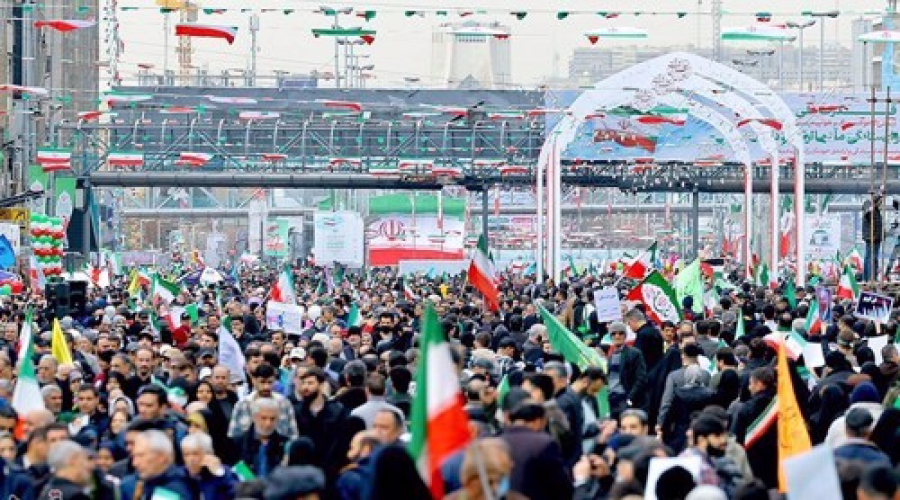
Iranians have marked the anniversary of the Islamic Revolution with nationwide rallies in their millions, sending a strong message of allegiance to the ideals of the late Imam Khomeini who upended the US-backed monarchy 47 years ago.
Huge crowds poured into Tehran’s main squares and into public spaces across roughly 1,400 cities and towns, braving chilly temperatures, rain and snow in a display of national unity amid provocations and threats by the US and Israel in recent weeks.
In Tehran, participants gathered from 9:30 a.m. local time and proceeded toward the iconic Azadi Square where President Masoud Pezeshkian addressed the massive crowd.
They chanted slogans in unison condemning decades of crimes by the United States against the Iranian nation, as well as the Israeli regime’s atrocities.
They also carried photos of the martyrs of the eight-year Iraqi war on Iran, the 12-day US and Israeli war in June, and the recent foreign-backed riots, as well as other martyrs who lost their lives in the line of duty.
About 7,200 domestic journalists and nearly 200 foreign media representatives covered the events, documenting public participation and related ceremonies and countering Western media narratives that downplay or mischaracterize such gatherings.
On Tuesday night, people across the country chanted “Allahu Akbar” at 9:00 p.m. to commemorate the victory of the Islamic Revolution. In many cities, especially Tehran, spontaneous crowds carrying Iranian flags gathered in public squares.
On Monday, Leader of the Islamic Revolution Ayatollah Seyyed Ali Khamenei called on the Iranian nation to demonstrate its will and steadfastness on the anniversary of the Islamic Revolution, saying such unity would frustrate the enemy.
The large-scale turnout follows riots on Jan. 8 and 9, when protests initially sparked by economic grievances on January 8 and 9 and turned into unruly scenes of mayhem and destruction. Armed groups infiltrated the demonstrations, leading to damage to shops, government buildings and public facilities, as well as casualties among civilians and security forces.
Iranian authorities confirmed that American and Israeli spy agencies were directly involved, providing funding, training, and media support to the perpetrators. According to a statement last month by Iran’s Foundation of Martyrs and Veterans Affairs, a total of 3,117 people lost their lives during the riots, including 2,427 innocent civilians and security personnel.
On the sidelines of the march, several burned and damaged vehicles destroyed during the recent foreign-backed riots were put on display. Officials said they had been set on fire and vandalized by rioters.
Following an insult to the Holy Qur'an during the January terrorist incidents by operatives trained by Mossad, some marchers held copies of the Qur'an and chanted, “Truth does not burn,” in condemnation.
Several cruise missiles — including Soumar, Noor, and Qadir — as well as ballistic missiles such as Zolfaghar, Haj Qassem, and Emad, were exhibited in Azadi Square.
In addition to the missiles, wreckage of several Israeli drones said to have been shot down during the 12-day war in June was also shown to participants in Azadi Square.
President Masoud Pezeshkian also attended the gathering of marchers in Tehran and delivered a speech to the participants in Tehran within the next few hours.
Marchers said in a resolution that their large and unifying presence represented “a clear manifestation of the Iranian nation’s political maturity, national cohesion, and historical vigilance” in the face of complex plots, mounting pressure, and a comprehensive hybrid war by the enemies of the Islamic Revolution, particularly the United States, Israel, and their allies.
The statement said recent events — including an “open aggression and imposed 12-day war” against Iran and the Resistance Front, as well as “bitter incidents of an American-Zionist coup attempt by armed terrorist elements” — had exposed the foe’s hostility and violence while also demonstrating to the world the resilience of Iran and its allies.
“With a deep understanding of the enemy’s hybrid, cognitive, and media warfare and with direct experience of the 12-day imposed war, we emphasize the necessity of preserving sacred unity, social solidarity, strengthening social capital, and avoiding any division or polarization,” the resolution declared.
It added that national cohesion and the close bond between the people and the Islamic system constitute the country’s most important support in confronting internal and external threats.
The rallies commemorate the Iranian people’s overthrow of the Pahlavi dictatorship, which had the full backing of the United States, in the winter of 1979.
Imam Khomeini returned from exile on February 1, 1979, receiving an enormous welcome from the public weeks after the shah’s departure in mid-January.
The downfall of the Pahlavi regime was sealed on February 11, 1979, when the military abandoned its allegiance to the shah and aligned itself with the Revolution.
Press TV’s website