
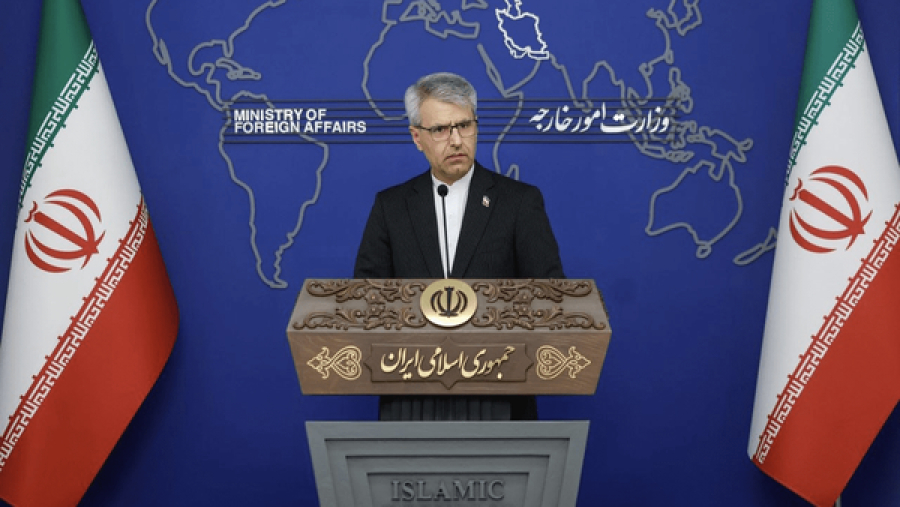
The Foreign Ministry spokesperson stated tonight that the visit of Pakistan's Interior Minister to Tehran concerns bilateral matters. He added that while it is natural for Pakistan—having put in significant effort as a mediator—to seize every opportunity for good offices, he has no information suggesting that a specific plan is set to be exchanged at this time.
Esmaeil Baghaei, the Foreign Ministry spokesperson, remarked in an interview tonight regarding the visit of Syed Mohsin Naqvi, Pakistan's Interior Minister, to Tehran, that relations between Iran and Pakistan are excellent.
Baghaei stated that the visit focuses on bilateral issues and noted that a Pakistani minister from the economic sector might be accompanying him.
He mentioned that discussions regarding previous understandings are on the agenda.
Responding to a question about whether the minister is carrying a message, the spokesperson said: "It is natural for Pakistan, as a mediator that has worked hard, to utilize every opportunity for good offices; however, I have no information indicating that a specific plan is to be exchanged."
The Foreign Ministry spokesperson also announced that Araghchi is scheduled to hold meetings with a significant number of his counterparts on the sidelines of the UN General Assembly session in New York.
In response to a question about whether the US has reacted to the three main conditions announced by Iran, the diplomatic spokesperson said: "What Iran has announced essentially constitutes the demands and fundamental principles of the negotiations and the understanding reached on June 18 [Khordad 28]—an agreement from which the US government withdrew and which it violated without any valid reason or pretext. Iran's demand for the cessation of sanctions and the lifting of the naval blockade remains firmly in place." He stated: As long as the naval blockade remains in place, it constitutes an act of aggression, and Iran cannot speak of ending the war or normalizing conditions in the region until these conditions are met.
Responding to a question regarding the understanding between Iran and Oman concerning the Strait of Hormuz, the senior Iranian diplomat remarked: The understanding reached between Iran and Oman should be viewed as an opportunity—and appreciated as such—by all countries, both within and outside the region.
Baghaei noted: Over the course of several weeks, the two littoral states held discussions on the precise coordinates of a safe route for commercial shipping, and the plan was to share the results of these negotiations with other regional countries at the Salalah meeting—an opportunity that was ultimately lost.
He further pointed out: However, this does not negate the efforts made by Iran and Oman. This understanding regarding the establishment of a safe route was reached between the two nations, and naturally, any future developments will hinge upon this very understanding.
Baghaei also announced that Araghchi and his Pakistani counterpart are scheduled to meet and hold talks on the sidelines of the UN General Assembly session in New York.