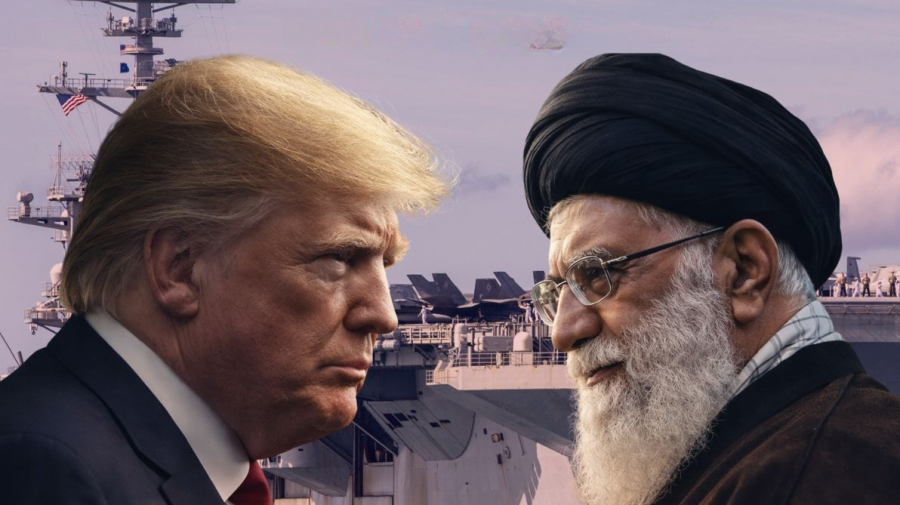
Yes, Iran has the military capability to do so, and at the right opportunity, this aircraft carrier and all its personnel could be sent to destruction and death. Iran is waiting for the right moment. Now we explain what the conditions are.
Amid rising tensions in West Asia and the deployment of a United States Navy carrier strike group led by the aircraft carrier Abraham Lincoln in the northern Arabian Sea, a long-standing question has once again emerged in strategic circles: Can Iran sink a U.S. aircraft carrier?
On paper, U.S. President Donald Trump could order an airstrike against Iran in the shortest possible time, but in practice, it is not that simple. Although America’s naval power is extremely impressive, Iran’s hands are not empty when it comes to confronting the U.S. Navy and its massive warships.
The aircraft carrier Abraham Lincoln, a nuclear-powered Nimitz-class carrier, carries about 60 F/A-18 Super Hornet fighter jets. This means that launching attacks on Iran from these aircraft is not as easy as it seems, and it is unclear whether U.S. carriers would be able to protect themselves against Iranian missile attacks in the event of war.
---
Missile cities versus carriers and fighter jets
Iran’s conventional air force is generally considered limited, largely because years of sanctions have prevented Iran from acquiring large numbers of modern fighter aircraft. However, Iran has compensated for this limitation by developing its missile capabilities.
Today, Tehran possesses one of the most diverse missile arsenals in the world, including short-range ballistic missiles, medium-range missiles, cruise missiles, and most importantly, hypersonic ballistic weapons. Hypersonic missiles travel at speeds greater than Mach 5, drastically reducing reaction time for the opponent.
According to military sources and based on Iran’s missile responses to Israel during the 12-day war, Iran has demonstrated that it possesses intercontinental missiles equipped with hypersonic systems such as the Fattah-2 missile. Some Iranian ballistic missiles are specifically designed to target ships and large naval vessels.
Some of these missiles were reportedly used by Yemeni forces in 2024 to target commercial and military vessels in the Gulf of Aden, and the Yemeni government confirmed purchasing these missiles from Iran.
In fact, the experience of Yemeni forces using Iranian anti-ship missiles during operations related to Gaza and against ships bound for Israel in 2024 demonstrates that Iran has sufficient missile capability to target warships at sea.
---
How vulnerable are American carriers?
The aircraft carrier Abraham Lincoln does not operate alone at sea. It is surrounded by a carrier strike group consisting of cruisers and destroyers.
According to Reuters, the Abraham Lincoln is protected by warships equipped with the Aegis combat system, one of the most advanced naval air defense networks in the world. This defensive shield operates in layers.
The outer layer includes electronic warfare systems designed to disrupt or confuse incoming missiles. Each destroyer carries about 90 air defense missiles, including the RIM-174 SM-6 interceptor, which has a range of over 400 kilometers. Newer versions also have ballistic missile defense capabilities, allowing them to intercept certain ballistic and hypersonic threats at various stages of flight.
However, a key question remains: how effective would this defense system be against a massive missile barrage from Iran, especially if more than 100 missiles were launched simultaneously?
Even the most advanced missile defense systems may struggle against saturation attacks, as intercepting more than 100 incoming missiles at once presents a major operational challenge.
---
How would Iran carry out such an attack?
Iran would likely rely on precise technical intelligence and careful operational planning.
According to India Today, Iranian forces could launch hundreds of long-range Shahed-136 drones alongside ballistic and cruise missiles toward U.S. naval vessels. This would aim to overwhelm defensive systems and force American warships to use up their interceptors.
After exhausting these defenses, hypersonic missiles with greater destructive power could then be launched toward the carriers.
A potential Iranian attack would likely involve two phases:
Launching large numbers of drones to deplete air defense interceptors
Launching ballistic missiles to strike the carrier itself
---
Geography: the decisive factor
Geographically, it is unlikely that U.S. aircraft carriers would enter coastal waters near Iran, such as the Persian Gulf or even the Gulf of Oman, because Iranian coastal missile forces would have maximum effectiveness there.
Instead, the Abraham Lincoln operates in the Arabian Sea, using geographic distance and terrain to increase defensive response time.
Aircraft carriers are not stationary targets. A Nimitz-class carrier weighs over 100,000 tons and can travel at speeds exceeding 25 knots, covering hundreds of kilometers per day. Carrier strike groups constantly change course to avoid predictable movement patterns.
For a successful attack, Iran would need rapid targeting, satellite surveillance, integrated command systems, and real-time missile launch capabilities.
Iran has invested in satellite tracking, navigation systems, and domestic space technology to improve its targeting capability.
In the past, GPS was the only global navigation option, but today countries such as China, Russia, Japan, and the United Kingdom have their own navigation systems. Iran has also sought to develop indigenous systems and integrate with non-Western satellite navigation networks.
---
Iran ready to test its naval deterrence
Despite these developments, sinking a U.S. aircraft carrier remains extremely difficult.
Iran could increase the risks and operational costs for U.S. naval forces, but destroying a carrier would require a complex combination of intelligence, timing, and weapon effectiveness.
Military experts note that naval deterrence is not based solely on weapon size, but on which side can detect, track, and strike first.
Iran appears to be working toward improving its missile, surveillance, and satellite capabilities to enhance its naval deterrence.