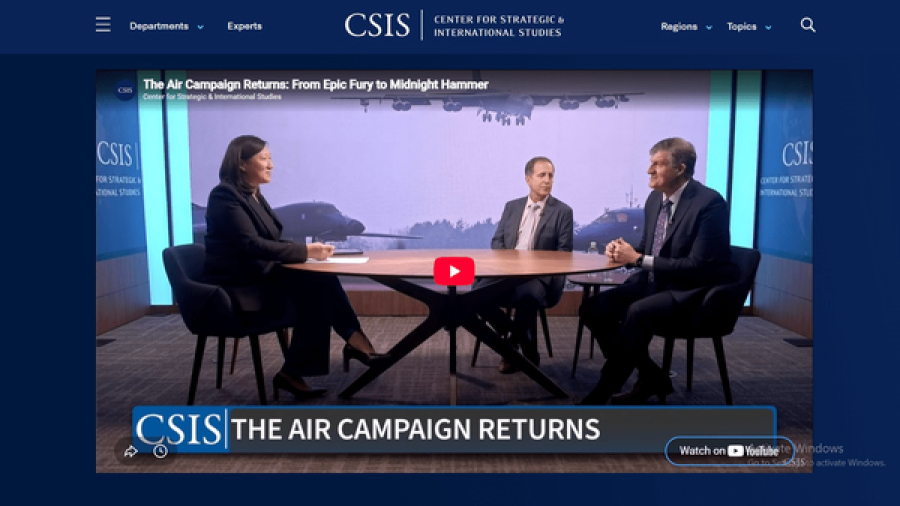
Two retired senior US Air Force commanders and current experts at the Center for Strategic and International Studies, while acknowledging the precise division of operational tasks between the US and Israel in attacking Iran, emphasize that no power can take control of the Strait of Hormuz from Iran and that Iran can impose its control over this strait as long as it wants.
Former US commanders admit Iran's eternal dominance over the Strait of Hormuz
Two retired senior US Air Force commanders and current experts at the Center for Strategic and International Studies, while acknowledging the precise division of operational tasks between the US and Israel in attacking Iran, emphasize that no power can take control of the Strait of Hormuz from Iran and that Iran can impose its control over this strait as long as it wants.
International Analysis Group: General James Slife, former Chief of Staff of the US Air Force, and his successor, General Clint Hinot, who are currently senior experts at the Center for Strategic and International Studies (CSIS), reveal in an expert interview the precise coordination and division of labor between the US and Israel in attacking Iran. They also admit that no power or military operation can take control of the Strait of Hormuz from Iran, and emphasize that the erosion caused by this war will have serious effects on the US military and defense structure in the next three to five years.
The US has no clear definition of winning this war
According to General Slife and General Hinot, one of the most prominent features of the US attacks on Iran was operational cooperation and extensive exchange of experience and information with Israel; of course, they do not consider these two levels of integration between the two sides to be comparable to the long-standing US cooperation with allies such as the UK and Australia.
Hinot continues this discussion by emphasizing that the operational superiority and success in destroying the intended targets remained essentially at the tactical and military level and failed to translate into strategic success. In his opinion, the fundamental weakness of the US-Israeli operation lies in this point; despite achieving some results on the battlefield, Washington lacks a clear and coherent theory of victory that explains how these military losses should force Iran to accept America's political goals; therefore, in the opinion of this retired pilot and commander, a serious gap has formed between the success in targeting on the one hand and the realization of the political end of the war on the other.
Coordination between the political structure and the US military forces is very weak
These two retired commanders believe that one of the fundamental difficulties in designing a military campaign against Iran is that vague political goals cannot be transformed into specific and implementable military missions.
Slife explains that current political leaders demand “options” from military commanders without clearly stating what political goals these options should achieve; as a result, military planners are forced to infer the government’s true intentions from public statements and indirect signals. This ambiguity creates a communication gap between the White House, the top levels of the Pentagon, and US Central Command; each may have a different understanding of the purpose of the war and the function of military power.
Hinot also claims that the consequence of this incoherence has been evident in the change in direction of the campaign; the operation began with a strategy of assassinating senior Iranian leaders, but subsequently Washington faced a more stubborn structure that tried to pressure it into accepting concessions such as giving up its nuclear program and fully opening the Strait of Hormuz. This was while the main decision-making centers were never willing to accept these demands and impose them on Iran’s political and military structure.
The precise division of labor between the United States and Israel to achieve specific goals
On the one hand, these two retired US Air Force generals try to distinguish between the political demands of the United States and Israel from this war, but their explanations of the tactical approaches are of a kind that clearly show that there is a tangible coordination and division of labor between the United States and Israel.
They claim that Israel's approach in this war against Iran is based on a "lawn-mowing" policy; since Tel Aviv considers the Iranian threat to be reproducing, it prepared itself for periodic attacks on its leaders, government structure and nuclear capabilities, and mainly targeted Iran's government centers and nuclear program.
The two then explain that the US approach at the tactical level is more focused on air defense, missile and drone production and other components of Iran's military power.
The two American generals claim that these different tactical approaches are likely the result of two different perceptions of the purpose of the war. Because Israel sees the simultaneous weakening of Iran, Hezbollah, and Hamas as a generational opportunity to change the regional balance, but Washington, in their view, seeks to exert pressure to achieve a desirable stable situation and reduce its conflict in the Middle East.
Both of these goals are complementary and do not conflict with each other. The United States seeks to destroy Iran’s deterrent capabilities, and Israel seeks to limit and eliminate Iran’s strategic depth and access to its cross-border forces and allies. The explanations of these two generals in this position are completely consistent, considering their initial claim of unprecedented US-Israeli coordination in attacking Iran.
Iranian drones ended a historic immunity in the US Air Force.