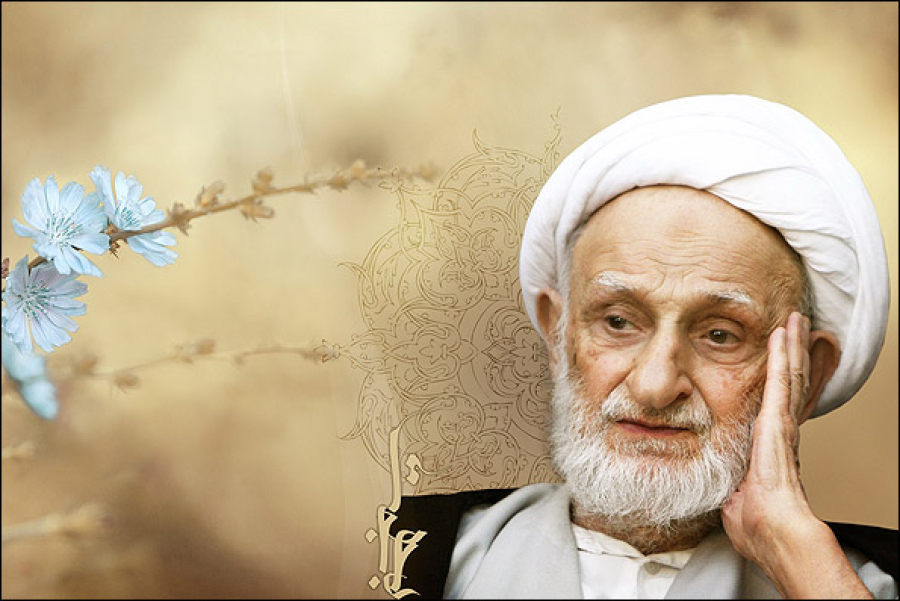
Ayatollah Bahjat: A Silent Mystic, an Anonymous Servant Among the People
Introduction
In the contemporary Shia world, few scholars have been able to become a “living spiritual reference point” for countless seekers of truth through an almost absolute silence and an unparalleled simplicity of life, as Ayatollah Mohammad Taqi Bahjat did. He had no extensive propagation program, published no numerous works, and did not even welcome fame or public attention; yet this very old man, secluded in spirit yet present among the people, was in the eyes of many top-ranking scholars the “lamp of his age.” This essay seeks, in the briefest form, to sketch the inner countenance of this mystic scholar and to open a window onto a world in which eighty years of questioning and burning flowed.
Ayatollah Bahjat’s life can be summarized outwardly in one word: “simplicity”; and inwardly in one word: “depth.” His biography contains almost no dramatic ups and downs: he was born in 1294 SH (c. 1915 CE) in Fuman, lost his mother in childhood, went to Iraq at the age of fourteen, and in Najaf benefited from the presence of great figures such as Mirza Naini and Sayyid Ali Qazi. What is noteworthy is that his spiritual wayfaring began in his youth—at seventeen or eighteen he found his way to Qazi’s presence, and according to those close to him, he experienced states that he would not disclose even to his nearest kin. This “apprenticeship in adolescence” is rare in the Islamic tradition, and its secret lies in a rare quality: absolute obedience in wayfaring and absolute concealment in discretion.
But what distinguishes Bahjat from many “spiritual guides” is his choice of a path almost contrary to the common custom. He held full jurisprudential authority, yet for fifty years he held his advanced jurisprudence lessons in his own home, not in a public mosque. He could have published many books, but repeatedly prevented the publication of his works, saying, “The manuscripts of earlier scholars are waiting to be printed; these are in no hurry.” He did not even use the Imam’s share to print his practical treatise; he published it with a personal loan. This “discipline of humility” is something beyond ordinary modesty: not using knowledge to gain influence, and not turning spirituality into a spectacle.
This apparent anonymity was itself the manifestation of his inner depth. The word most frequently used to describe him is “zuhd” [detachment], but Bahjat’s detachment was not self-tormenting asceticism, but rather a complete selflessness. His house did not change for decades and his old belongings remained in place; he walked in the street in such a way that passersby did not recognize him, for he erased from himself every sign that would set him apart from others. His son relates that while walking he would not look right or left and would not glance behind him; very calm and dignified, yet without any arrogance. This “not being recognized” is one of the loftiest secrets in the Islamic mystical tradition: the perfect human is known not by being recognized, but by being forgotten.
Bahjat’s words were few, but every sentence carried practical weight. His teachings to seekers can be summarized in three layers: First, honest self-reckoning. He said: “We do not know our own disease, otherwise the cure would be easy.” This simple sentence marks the first threshold of wayfaring: admitting the soul’s illness. Second, specific and small action. Instead of abstract discussions, he recommended the simplest acts of worship: seeking forgiveness a hundred times daily, reciting Surah al-Waqi‘ah before sleep, and giving charity and supplication in hardships. Third, balance between trust in God and precaution. His central statement was: “If we act upon what we are certain of and exercise precaution in what we doubt, God will show us the way.” This sentence gathers within itself the tension between juristic precaution and mystical openness: the boundaries of the Shari‘ah are the starting point of freedom, not its end.
Conclusion
Ayatollah Bahjat did not leave the world, first of all, a legacy of the “book” kind—though many of his manuscripts and teachings have gradually been published in books such as In the Presence of Bahjat (in three volumes, containing about 1,800 points and recommendations), Pure Points from Grand Ayatollah Bahjat, Bahjat al-Faqih, Jami‘ al-Masa’il, Istifta’at, and Risalah Tawdih al-Masa’il, and the software collection Bahjat al-Faqih has gathered seven of his works in sixteen volumes—rather, he left a “lived example.” He showed that a human being in the heart of the modern world, with the highest scholarly authority, without any media tools and without any conformity to public expectations, could become a center of spiritual attraction beyond the boundaries of culture and language solely by relying on inner sincerity and silent steadfastness. For a reader weary of the noisy marketplace of spirituality and seeking a more sincere inner life, Bahjat’s life itself is a prescription:
“Speak little, be seen little, possess little; ask much, persevere much, and burn much where no one sees. This gate has been opened; the view beyond it is worthy of every sincere seeker stepping through it himself.”