Introduction
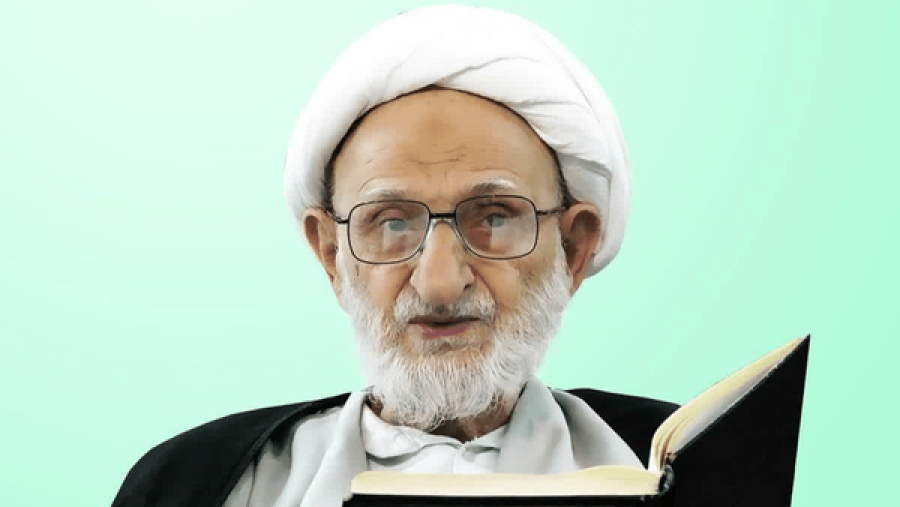
Every night, when we lay our heads on the pillow, before we fall asleep, there is a moment in which all roles collapse. No status remains, no preoccupation, no performance. We are only ourselves, and the silence we flee from. From this small, everyday moment, Ayatollah Bahjat had opened a door toward the greatest truth of existence: the remembrance of death and the Hereafter. And the prescription he had for this moment was nothing but reciting Surah al-Waqi‘ah. On the surface, this advice is a simple recommended act; but in his view, it was a nightly exercise in “waking up.”
Text
Surah al-Waqi‘ah is the surah of the Resurrection. It speaks of the moment when mountains crumble and the earth is transformed. And this is precisely what makes reciting it before sleep meaningful: before a person goes to sleep, he remembers that one day he will wake from a sleep far heavier. Sleep is a small rehearsal of death; and Surah al-Waqi‘ah is a mirror that brings this rehearsal out of heedlessness.
A narration has been reported from Imam al-Baqir (peace be upon him) that “whoever recites Surah al-Waqi‘ah every night before sleeping will meet God, the Honorable and Great, with a face like the full moon.” This reward is the reward of “seeing.” One who sleeps every night with the remembrance of the Resurrection gradually acquires an eye that sees beyond this world. Ayatollah Bahjat regarded this not as a distant promise but as a practical path. He himself, in describing death, would say: “Death has no fear. Externally, it is the same as sleep.” If death is the same as sleep, then every night one can prepare oneself before it. Reciting al-Waqi‘ah is preparation for that “great awakening.”
But the deeper ethical point is here: how can one who sleeps every night remembering the Resurrection live the next day? Surah al-Waqi‘ah divides people into three groups: the foremost, the companions of the right, and the companions of the left. Reciting this surah before sleep is in fact a question we ask ourselves every night: “Which group will I wake up in tomorrow morning?” This question corrects intentions and shapes the behavior of the next day. The gnostics have said that the smallest continuous act is more effective than the greatest occasional act. Reciting al-Waqi‘ah every night is exactly of this kind: not a heavy task, but a light window that is opened every night.
Conclusion
By advising the recitation of Surah al-Waqi‘ah before sleep, Ayatollah Bahjat has in fact given us a “nightly exercise.” An exercise so that we do not go to sleep before remembering death; and so that we wake before the opportunity ends. Tonight, before sleep, recite Surah al-Waqi‘ah once — not in haste, but with this question: “Which group will I wake up in tomorrow morning?” Perhaps this single question is the beginning of the transformation Ayatollah Bahjat spoke of.
Next Article: In the next article, we will discuss the balance of trust in God and caution in the life of Ayatollah Bahjat, and how the boundaries of sharia are the starting point of freedom, not its end.
Sources
· The Holy Qur’an, Surah al-Waqi‘ah.
· Office of Ayatollah Bahjat, In the Presence of Bahjat, vol.
· Rakhshad, Mohammad-Hossein. In the Presence of Ayatollah Bahjat. Qom: Sama.
· Official website of the Office of Ayatollah Bahjat (bahjat.ir).